

Custom Website Design: What to Look for When Hiring a Local Agency
Hiring a web design agency is one of the most important decisions a growing business makes. This guide breaks down exactly what to look for, what to budget, and how to tell a great agency from a mediocre one.

What Is Custom Website Design and Why Does It Matter?
Custom website design means a site built from scratch around your specific brand, audience, and goals rather than dropped into a pre-made template. That difference shows up in load speed, conversion rates, and how well the site holds up as your business grows. Template-based website builders like drag-and-drop platforms can get a basic page live in a weekend, but they carry structural limitations that become visible the moment you need something outside the builder’s defaults.
A custom-built site gives you full control over layout, performance, and code. Google’s Core Web Vitals scoring rewards pages that load quickly, respond to user input fast, and shift their layout as little as possible during load. Template platforms often inject bloated code that drags those scores down, while a custom build is trimmed to exactly what the page needs.
For businesses competing in dense urban markets, the gap between a generic template and a purpose-built site is not cosmetic. Visitors form a first impression in roughly 50 milliseconds, according to research published in Behavior and Information Technology. A site that looks and performs like a professional investment signals that the business behind it is serious.
Visitors form a first impression in roughly 50 milliseconds, and a site that looks and performs like a professional investment signals that the business behind it is serious.

How Do You Choose a Web Design Agency?
The best way to choose a web design agency is to evaluate their portfolio, ask about their discovery process, and confirm they can handle SEO, mobile optimization, and ongoing support, not just visual design. An agency that leads with aesthetics but skips strategy will hand you a beautiful site that nobody finds.
When researching how to choose a web design agency, start with these questions during your first call:
- Portfolio depth: Do they have examples in your industry or with comparable complexity?
- Discovery process: Do they ask about your customers, competitors, and conversion goals before quoting?
- SEO integration: Is on-page SEO built into the project, or sold as a separate add-on after launch?
- Mobile-first approach: As of 2024, Google indexes the mobile version of a site first, so mobile optimization is not optional.
- CMS training: Will you be able to update content yourself after handoff, or will every edit require a paid support ticket?
- Analytics setup: Do they configure Google Analytics or a comparable reporting tool so you can measure results from day one?
- Post-launch support: What does ongoing maintenance cost, and what does it cover?
Red flags are just as revealing as green ones. An agency that sends a proposal within hours of your first contact, without asking a single question about your business, is almost certainly templating your project before they understand it. Our team always asks for analytics access before quoting a redesign, because the pages a client wants to cut are often the ones bringing the most traffic.
Checking references matters too. Ask past clients specifically whether the project was delivered on time, whether the final cost matched the quote, and whether the site performed as promised in the first 90 days after launch.
What Does a Custom Website Design Cost?
In the regional market across Southern California and nationally, custom website design projects typically range from $3,000 to $8,000 for a small business site and from $10,000 to $50,000 or more for complex e-commerce or enterprise builds. The factors that move a project toward the high end include the number of pages, custom functionality, third-party integrations, and the depth of SEO and content work included.
The table below breaks down the main cost drivers so you can estimate where your project is likely to land.
| Cost Factor | Lower-Cost Scenario | Higher-Cost Scenario |
|---|---|---|
| Page count | 5 to 10 pages | 50 or more pages |
| E-commerce | No online store | Full product catalog with payment processing |
| Custom functionality | Contact form, basic blog | Booking systems, member portals, custom APIs |
| SEO scope | Basic on-page setup | Full keyword research, content strategy, local SEO |
| Content creation | Client supplies all copy and photos | Agency writes copy and produces photography |
| Brand strategy | Existing brand assets used as-is | Logo, color system, and typography developed from scratch |
| Ongoing support | One-time handoff | Monthly retainer for updates, security, and analytics |
Beware of quotes that seem unusually low. An agency offering a full custom site for under $1,500 is almost certainly using a page builder theme and calling it custom. That is not inherently wrong, but it should be disclosed upfront, and you should know the difference before signing.
For a personalized estimate, request a custom quote from Dreem Websites at (818) 699-6244. Pricing varies with scope, and an honest agency will not quote a number before understanding your project.
What Should a Custom Website Design Include?
A professionally built custom site should include mobile optimization, on-page SEO, a content management system you can update yourself, analytics tracking, and a clear conversion path from every major page. These are not premium add-ons; they are the baseline for a site that actually earns its cost.
Here is what to expect in a complete custom website design project:
- Mobile optimization: Google’s mobile-first indexing, in place since 2019 and reinforced through the 2024 algorithm updates, means a site that performs poorly on phones will rank poorly everywhere. Every layout, image, and button should be tested on screens as small as 375 pixels wide.
- Search engine optimization: On-page SEO includes proper heading structure, title tags, meta descriptions, image alt text, schema markup, and internal linking. This is work done during the build, not bolted on afterward.
- Content management system (CMS): A good CMS lets your team publish blog posts, update service pages, and swap images without touching code. Popular options include WordPress, Webflow, and Craft CMS, each with different tradeoffs in flexibility and ease of use.
- Analytics and reporting: A site without tracking is a site you cannot improve. Your agency should connect Google Analytics 4 (GA4) or a comparable platform and confirm that key events, like form submissions and phone-number clicks, are being recorded before handoff.
- Performance optimization: Images should be compressed and served in modern formats like WebP. Code should be minified. Third-party scripts should be loaded only when necessary. These steps directly affect Core Web Vitals scores and, by extension, search rankings.
- Security basics: SSL certificate, regular software updates, and a backup plan. As of 2026, browsers flag any site without HTTPS as “not secure,” which destroys trust before a visitor reads a single word.
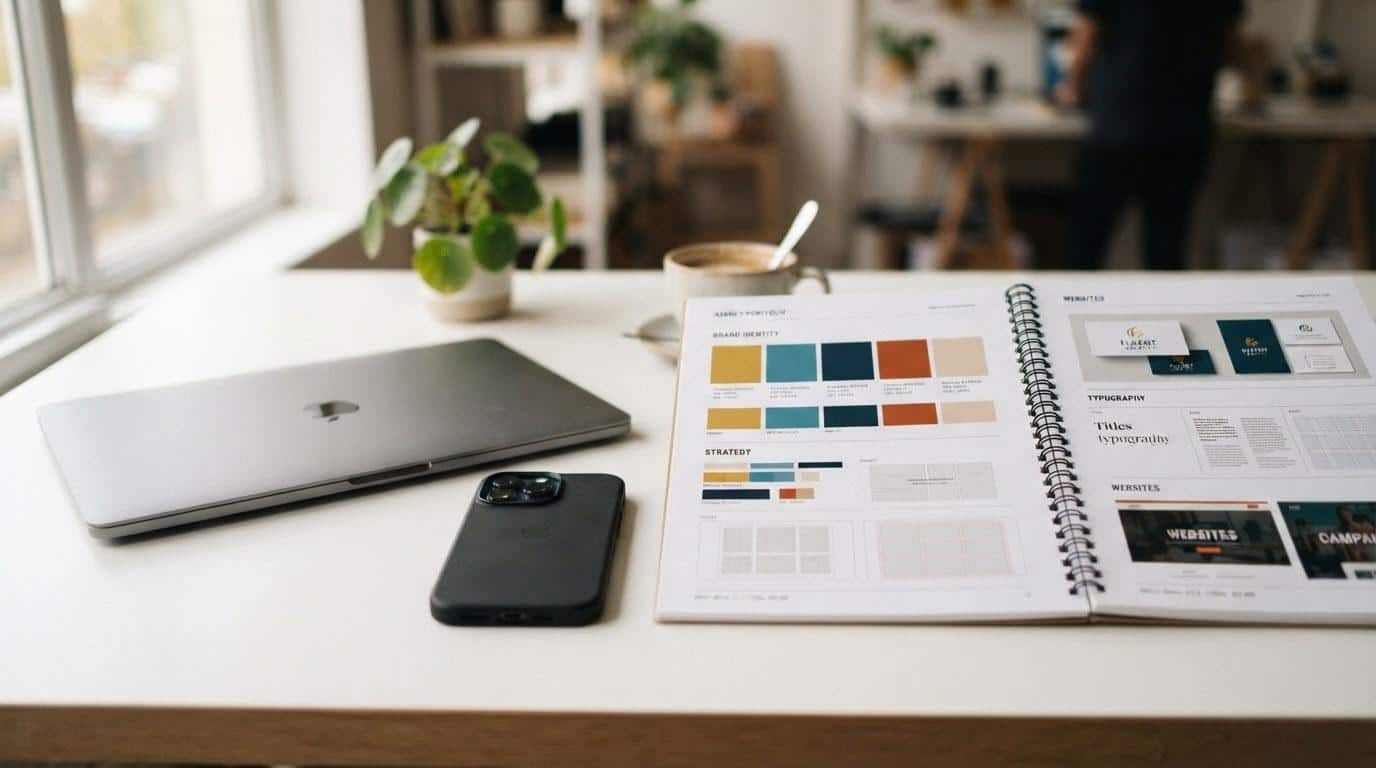
- Brand consistency: Fonts, colors, button styles, and imagery should follow a defined system so every page feels like the same company. A brand strategy document produced before design begins prevents costly revisions later.

What Are the Most Common Mistakes Businesses Make When Hiring a Web Agency?
The most common and expensive mistake is choosing an agency based on price alone, without evaluating their process, their portfolio, or their understanding of your industry. A low quote that doubles during the project is far more costly than a higher quote that stays accurate.
Other frequent mistakes include:
- Skipping the discovery phase: Jumping straight to design without agreeing on goals, audience, and success metrics leads to a site that looks good but does not convert visitors into customers.
- Ignoring SEO until after launch: Retrofitting SEO onto a finished site is harder and less effective than building it in from the start. Google’s SEO Starter Guide makes clear that site structure, URL patterns, and heading hierarchy all affect crawlability, and those decisions are made at the architecture stage.
- Not owning your own assets: Some agencies retain ownership of the domain, hosting account, or source files. Before signing, confirm in writing that you will own every asset when the project ends.
- Underestimating content: Design can only be finalized around real content. Businesses that delay providing copy and images often extend their own timelines by 4 to 8 weeks and then blame the agency for the delay.
- Choosing a builder platform when you need a custom build: Website builders are fine for simple informational sites. But if you need custom booking logic, a member area, complex product filtering, or deep SEO control, a builder’s constraints will cost you more in workarounds than a custom build would have cost upfront.
- No post-launch plan: A website is not a one-time project. Search rankings, security patches, and content freshness all require ongoing attention. Agree on a maintenance plan before launch, not after something breaks.
How Does the Custom Website Design Process Work, Step by Step?
A professional custom website design process moves through five phases: discovery, strategy, design, development, and launch. Each phase has defined deliverables, and skipping any one of them creates problems in the phases that follow.
- Discovery: The agency learns your business, your competitors, your customers, and your goals. This typically takes 1 to 2 weeks and produces a project brief that both sides agree on before any design work begins.
- Strategy: Site architecture, page structure, keyword targets, and conversion paths are mapped out. This is where decisions about the CMS, hosting environment, and third-party integrations are made. A well-run strategy phase prevents expensive changes during development.
- Design: Visual mockups are created, usually starting with a homepage and one or two interior page templates. Expect at least 2 rounds of revisions. The final approved designs become the blueprint for development. This phase typically runs 2 to 4 weeks depending on project complexity.
- Development: Designers hand off approved files to developers who build the site in the chosen CMS. Functionality is coded, content is entered, and SEO elements are implemented. A mid-sized site typically takes 4 to 8 weeks in development.
- Testing and launch: The site is tested across devices, browsers, and screen sizes. Forms, payment flows, and tracking are verified. Once approved, the site goes live. A good agency runs a pre-launch checklist of at least 30 items covering performance, SEO, security, and accessibility before flipping the switch.
After launch, the first 30 days are critical. Monitor analytics daily to catch any traffic drops, broken links, or pages that are not indexing. Most agencies offer a 30-day post-launch support window; confirm this is in your contract before signing.
This custom website design guide is built around that five-phase process because it is the structure that produces predictable, measurable results. Any agency that cannot describe their process in concrete phases is improvising, and your project will show it.
Ready to Build a Site That Works for Your Business?
The right agency will ask more questions than they answer in the first meeting, show you relevant portfolio work, and give you a written scope before asking for a deposit. Those are the signals that separate a professional partner from a vendor who is just selling deliverables.
Dreem Websites works with businesses across Southern California and beyond to build custom websites that are fast, search-optimized, and designed around real conversion goals. Whether you need a brand-new site, a full redesign, or an e-commerce build, the team starts with your business objectives, not a template library.
Call (818) 699-6244 to schedule a discovery conversation, or visit the Dreem Websites website to request a custom quote. Bring your current site, your competitors’ sites, and your goals. That is all you need to get started.
Frequently Asked Questions
How much does a custom website design usually cost?
Custom website design projects typically range from $3,000 to $8,000 for a small business site in the regional market, and from $10,000 to $50,000 or more for complex e-commerce or enterprise builds. The biggest factors are page count, custom functionality, whether the agency handles copywriting, and how much SEO work is included. Template-based builds sold as custom are often priced below $2,000, but they come with structural limitations that surface quickly. Request a detailed written scope before comparing quotes so you are evaluating the same deliverables.
What exactly is custom website design?
Custom website design means your site is built from scratch to match your specific brand, audience, and business goals rather than fitted into a pre-made template. The layout, code structure, navigation, and conversion paths are all designed for your situation. This is different from using a website builder or a theme, where you are working within the constraints of someone else's design decisions. The result is a faster, more flexible site that can be adapted as your business changes.
How do I know if I need a custom site or a website builder?
A website builder works well if you need a simple informational site with fewer than 10 pages and no complex functionality. If you need custom booking logic, a member portal, advanced product filtering, or deep control over SEO settings, a builder's built-in limits will cost you more in workarounds than a custom build would have cost from the start. As a general rule, if your site is a significant part of how you generate revenue, a custom build is the better long-term investment.
How long does a custom website design project take?
Most small to mid-sized custom website projects take between 8 and 16 weeks from the first discovery meeting to launch. Discovery and strategy typically take 1 to 2 weeks, design takes 2 to 4 weeks, and development runs 4 to 8 weeks depending on complexity. The most common source of delays is the client taking longer than expected to provide content, copy, and approvals. Agreeing on a content deadline at the start of the project keeps timelines on track.
What should I ask a web design agency before hiring them?
Ask to see portfolio examples in your industry or with comparable complexity. Ask how they handle SEO during the build, not after. Confirm that you will own the domain, hosting account, and all source files when the project ends. Ask what the post-launch support period covers and what it costs. Finally, ask them to describe their design and development process in concrete phases. An agency that cannot answer these questions clearly is not ready to manage your project.